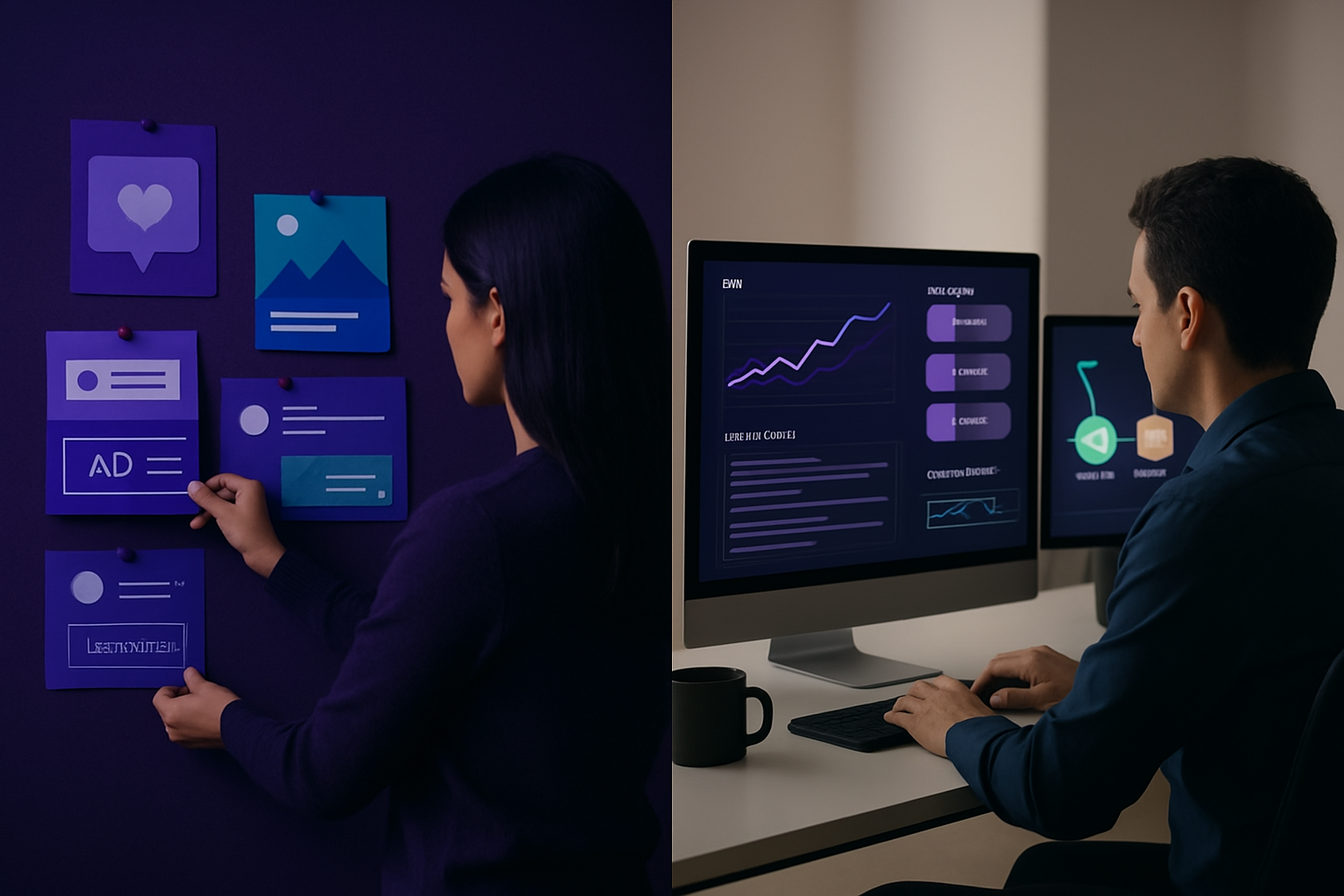
An AI automation agency builds systems that run processes without human intervention: it qualifies leads, answers customer conversations, orchestrates integrations between tools and makes decisions based on real-time data. Traditional digital agencies deliver presence (website, social media, campaigns), but they stop at the content and acquisition layer. AI automation goes into operations, replaces repetitive tasks and connects the systems the company already uses.
TL;DR: Digital agencies build storefronts and drive traffic. AI automation agencies build the internal engine that converts, qualifies and executes, integrating CRM, WhatsApp, e-commerce and management tools with intelligent agents.
The difference lies in where the delivery ends: one creates presence, the other creates autonomous operational capacity.
What a digital agency delivers (and where it stops)
Digital agencies solve visibility and top-of-funnel conversion: they build websites, create brand identities, run Meta Ads and Google campaigns, produce social media content and optimize SEO.
The result is qualified traffic and a consistent presence. But the work ends when the lead arrives. What happens next (qualification, follow-up, CRM integration, inventory updates, transactional emails) still depends on people or on disconnected systems.
Real example: a fashion e-commerce client of ours received 400 messages a week on Instagram asking about availability and delivery times. Their digital agency set up the profile, ran the ads and even configured generic auto-replies, but every specific question ("do you have the 38 in black?") turned into manual work.
The digital agency wasn't hired to fix processes; it was hired to create presence. And it delivered.
What an AI automation agency delivers differently
An AI automation agency builds smart workflows that execute tasks, integrate systems and make decisions based on rules or language models.
The deliverable isn't a website or a campaign. It's an agent or workflow running 24/7, connected to the CRM, WhatsApp, e-commerce platform, ERP or management tool.
What falls within the scope of an AI automation agency
- Customer service agents: they answer complex questions on WhatsApp, check inventory in real time, create orders in the system and book appointments in Google Calendar, all without human intervention until the handoff to sales or specialized support.
- Lead qualification with context: a lead coming from an ad is automatically scored, enriched with third-party data (LinkedIn, Clearbit), segmented and routed to the right salesperson, with the journey history attached.
- Orchestrated integrations: when a sale closes in Stripe, the workflow creates the customer in the CRM, triggers an onboarding email, provisions system access, notifies CS on Slack and schedules the first call, in seconds and without a paid Zapier plan.
- Continuous analysis and decision-making: AI-powered dashboards that extract insights from conversations, tickets, NPS and campaign metrics, pointing out where the conversion or churn bottleneck is before it ends up in a biweekly report.
AI consulting maps where operations get stuck, designs the ideal workflow and delivers the agent or automation up and running: integrated, trained and with a documented handoff.
Digital agency vs. AI automation agency: comparison table
| Dimension | Digital agency | AI automation agency |
|---|---|---|
| Main deliverable | Website, brand identity, campaigns, content | Smart workflows, agents, integrations |
| Focus | Presence and traffic acquisition | Autonomous operations and process efficiency |
| Typical tools | Figma, WordPress, Meta Ads, Google Ads | n8n, Make, LangChain, official WhatsApp API, CRM APIs |
| Measurable result | Traffic, impressions, cost per lead | Hours saved, automation rate, response time |
| Handoff | Delivers the lead or the visit | Delivers the qualified, routed lead, or the resolved conversation |
| Client profile | Company that needs to be found | Company that needs to scale without hiring |
The digital agency sets the stage. The AI automation agency puts robots on stage to perform the script.
Real cases only AI automation can solve
1. Fashion e-commerce: stock inquiries and order creation via WhatsApp
The digital agency delivered the Shopify store, Meta campaigns and an Instagram presence. Traffic grew 230% in three months, but customer service became the bottleneck.
We implemented an AI agent for e-commerce connected to the official WhatsApp API: the customer asks "do you have the cargo pants in size 40 in green?", the agent checks Shopify in real time, confirms availability, sends a product photo and a payment link. If the customer confirms, it creates the order. If they ask for a discount or customization, it hands off to a human with full context.
Result: 61% of stock inquiries resolved without human touch, and average response time dropped from 4h to 8 seconds.
2. Dental clinic: scheduling, reminders and smart rescheduling
The digital agency built the website with a contact form and ran local Google Ads campaigns. Leads came in, but 40% didn't confirm their appointment or no-showed without notice.
We built an AI agent for clinics that books directly into the dentist's Google Calendar, sends a WhatsApp reminder 24h in advance, confirms attendance and, if the patient asks to reschedule, suggests the next available slots and updates everything on its own.
Result: the no-show rate fell from 22% to 7%, and the receptionist was freed up to focus on procedures and treatment upsells.
3. Real estate agency: qualifying launch leads and guided virtual tours
A digital agency ran a lead generation campaign for a condo launch, generating 850 leads in two weeks. The sales team drowned: 70% were just curious or didn't fit the credit profile.
We implemented an AI agent for real estate agencies that, when contacted via WhatsApp or a form, asks qualification questions (income, intended use, timeline, financing), checks unit availability in the CRM, sends a narrated virtual tour and schedules an in-person visit only for high-fit leads. Cold leads receive automated follow-up for 90 days.
Result: the sales team focused on the 18% of hot leads, the visit → proposal conversion rate rose 3.2×, and the sales cycle got 12 days shorter.
When to hire an AI automation agency (and when it's still too early)
You need AI automation if:
- You receive more than 50 messages/leads a week and keep answering the same questions.
- You use 3+ tools (CRM, WhatsApp, sales platform, spreadsheet, email) and copy information between them by hand.
- Your growth bottleneck is team capacity, not traffic.
- You already have a working digital presence (website, social media, ads), but conversion or operations are stuck.
You don't need it yet if:
- Your website doesn't exist or doesn't convert even with paid traffic: fix your presence before automating processes.
- Volume is low (<20 interactions/week) and the cost of building automation outweighs the efficiency gain.
- Your team doesn't know how to use its current tools: automation on top of a broken process amplifies the problem.
AI automation scales what already works. If the manual process hasn't proven fit yet, invest first in validating the offer and the conversion.
How an AI automation agency delivers in practice
The project cycle follows four stages, usually taking 3 to 8 weeks depending on complexity:
1. Process mapping and diagnosis (week 1)
An immersion session with the team: we map where manual work happens, which systems are already in use, which integrations exist and where the bottleneck is. We come out with the workflow designed (usually in Miro or Whimsical) and the list of required APIs or connectors.
2. Agent or workflow design (week 2)
We define who does what: what the AI decides on its own, what needs human approval, how the handoff works and where fallback kicks in. We choose the stack (n8n for orchestration, LangChain if there's RAG, the official WhatsApp API for customer service, Supabase or Airtable for state management). We validate the technical feasibility of each integration.
3. Agent development and training (weeks 3-6)
We build the workflow in a staging environment, integrate the APIs (CRM, e-commerce, calendar, database) and train the language model with the company's FAQs, product catalog and policies. We test edge cases: what happens if the customer sends audio, asks something out of scope, swears or requests a cancellation.
4. Go-live and handoff (weeks 7-8)
We run in production with controlled volume (20% of traffic), adjust responses and workflows based on real feedback, document the maintenance playbook and train the team to monitor, tweak prompts and escalate. We hand over access to the dashboard (n8n, logs, metrics) and provide support for 30 days.
Critical difference: a digital agency delivers and closes the contract. An AI automation agency usually keeps a maintenance and continuous improvement contract, because agents need retraining as catalogs, policies and seasonality change.
Tools an AI automation agency masters (and a digital agency ignores)
| Tool | Function | Why digital agencies don't use it |
|---|---|---|
| n8n | Workflow orchestration, integrations across 400+ apps, self-hosted | Their focus is visual no-code (Webflow, Elementor), not process logic |
| Make (Integromat) | Visual automation for complex SaaS integrations | They use basic Zapier at most; Make requires thinking in branches, routers and filters |
| LangChain / LlamaIndex | Framework for building LLM applications, RAG and agents | They don't deal with backend or AI; they stop at ChatGPT prompts |
| Official WhatsApp Business API | Programmatic sending, webhooks, approved templates, integrated CRM | They use the WhatsApp Business App (manual) or Manychat (limited to broadcasts) |
| Supabase / Xano | Backend as a service with real Postgres, auth and functions | They use Airtable or Google Sheets; they don't design relational databases |
| Voiceflow / Botpress | Platform for building complex conversational agents | They stop at FAQ chatbots with no context or memory |
The AI automation stack is process- and integration-oriented. The digital agency stack is interface- and content-oriented.
The limits of what AI automation can do (for now)
Not everything can be automated, and honest agencies say so before selling:
- Highly subjective decisions: approving a creative proposal, defining brand positioning, negotiating a strategic partnership. These require human judgment that AI can't reliably replicate.
- Tasks that require genuine empathy: calming down a furious customer, mediating a conflict between partners, giving developmental feedback to an employee. AI can help with a script or suggestion, but the final conversation is human.
- Processes that change every week: if the business rule is unstable or still being discovered, automating early becomes expensive rework. Validate manually before investing in a workflow.
- Integrations with legacy systems without an API: an old ERP with no webhook, a management system that only exports .xls manually. Scraping or RPA is possible, but cost and fragility sometimes outweigh the gain.
The ideal AI automation doesn't replace everything: it frees the team from repetitive tasks so they can focus where human judgment really matters.
Our AI consulting starts by mapping what is worth automating now and what should wait for the process to mature.
Key takeaways
- A digital agency builds presence and drives traffic; an AI automation agency builds autonomous operational capacity that qualifies, serves and integrates.
- The AI automation deliverable is a workflow running in production, not a mockup or a campaign, and it usually requires ongoing maintenance.
- Real cases show gains in response time (hours → seconds), automation rate (60-80% of inquiries resolved without a human) and team focus (freed from repetition for sales/strategy).
- The AI automation stack (n8n, LangChain, WhatsApp API, Supabase) is radically different from the digital agency stack (Figma, WordPress, Meta Ads).
- Not everything can be automated: subjective decisions, real empathy and unstable processes still need a human in charge.
Scale operations without scaling headcount
If your company already has a working digital presence but the bottleneck is now people (slow customer service, manual follow-up, leads lost between tools), AI automation solves it.
We map where the process gets stuck and design the workflow.